

AI Mode Is Coming to Google Search: Will Your Practice Be Ready?
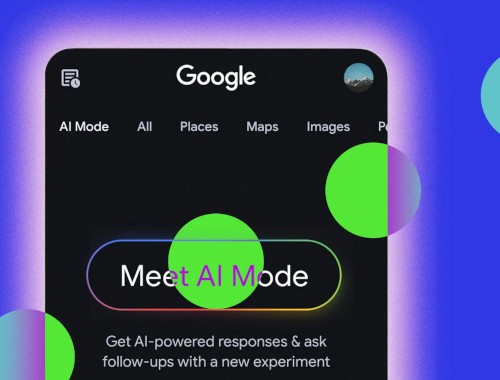 What if I told you that the way people use Google Search is on the verge of its biggest shift in decades? Google's new AI Mode isn’t just a tweak—it’s a significant change that could quietly redefine how online visibility works.
If you’re thinking, "our website’s pretty good, we’ll be fine," it’s worth thinking again. AI Mode is about to reshape how patients discover and choose services online. Health care and optical service providers that don’t adapt could find themselves with the online presence of a fax machine by the end of 2025.
This isn’t a drill—it’s your early warning signal.
What's New About "Google AI Mode"?
What happens when the world’s biggest search engine stops playing tour guide and decides it wants to be the destination? That’s the revolution which Google AI Mode brings to the table.
Yes, Google has been flirting with this idea for a while—rich snippets, knowledge panels, "people also ask" boxes. But what we are talking about here isn’t a tweak or an enhancement. It’s a total paradigm change.
Imagine walking into a vast department store, asking for running shoes, and instead of being shown the way to an aisle, you’re intercepted at the door. A concierge picks out three options for you, tells you why they’re great, answers follow-up questions you hadn’t even thought of yet—and gently nudges you towards a decision before you’ve taken ten steps inside.
No browsing. No wandering. Most of the decision making "heavy lifting" is being done without you even asking.
In this new world, if your practice isn’t one of those handpicked recommendations, you don't exist. There’s little opportunity for curious customers to stumble across you.
Having your website rank for a few keywords won't be enough anymore. Essentially, you are auditioning for inclusion in AI's suggested online destinations — and only the clearest, most trusted voices make it onto that short list.
That might sound like gloom and doom, but let's take the "glass half full" perspective.
AI Mode is going to hand REAL experts an unfair advantage — if they know how to be one of the fortunate few who get recommended.
Existing AI Overviews Compared To Google AI Mode
It’s worth appreciating exactly how the Google search experience is about to change.
How AI Overviews Compare to AI Mode:
| Feature | AI Overviews | Google AI Mode |
|---|---|---|
| Interface | Integrated into standard search results | Separate, chat-like conversational interface |
| Interaction | One-time summary | Multi-turn, interactive conversations |
| Input Types | Text and voice inputs via Google Lens | Text, voice, and image inputs |
| Complex Query Handling | Basic summaries for straightforward queries | Advanced reasoning for complex, multi-part queries |
| Availability | Global, including Australia | Limited testing in U.S.A. via Google Labs |
| Ideal Use Cases | Quick answers to simple questions | In-depth exploration, comparisons, and research |
Google hasn’t officially confirmed when Google AI Mode will roll out globally — but all signs suggest it’s not a question of if, only when. Google AI Mode is currently in limited testing via Search Labs in the U.S.A.
Based on Google’s typical pace of scaling new features, it’s realistic to expect broader public access to Google AI Mode sometime in the second half of 2025. Practices that prepare now will be ready to capitalise when Google AI Mode inevitably becomes the "new normal".
Conversational Discovery Is Replacing Traditional Search
Typing a few keywords into a search box and sifting through "ten blue links" is starting to look like yesterday’s internet.
And it’s not just Google AI Mode leading the charge. A growing roster of powerful platforms is reshaping how people find information through conversational enquiries.
Key AI Platforms Redefining Search:
| Product Name | Owned By | Powered By | Strengths | Limitations |
|---|---|---|---|---|
| Google AI Mode | Gemini family (Gemini 1.5, etc.) | Deep conversational search, integration with Google ecosystem | Limited rollout (only in U.S.A. testing via Google Search Labs) | |
| Perplexity | Perplexity AI Inc. | OpenAI GPT-4, Claude, internal fine-tuned models | Real-time web retrieval, cited sources, live browsing | Not an original foundational model yet (still hybrid sourcing) |
| Claude (chatbot) | Anthropic | Claude 3 family models | Nuanced reasoning, strong on AI safety and alignment | Less aggressive about citations; slower adoption compared to ChatGPT |
| DeepSeek Chat | DeepSeek (research consortium) | DeepSeek LLM, DeepSeek-V2 | Open-source, multimodal (text/image), emerging alternative | Early stage; smaller ecosystem, less polished than competitors |
| ChatGPT | OpenAI | GPT-3.5, GPT-4, GPT-4o | Excellent summarisation, conversational ability, plugin options | Defaults to static training data unless browsing is enabled |
But in case you were wondering, this doesn’t mean traditional SEO is dead. Far from it.
In this new "conversational discovery" environment, solid SEO fundamentals are more important than ever — because every AI model still relies on understanding the live web (or static training data from the web) to generate accurate recommendations.
If your website is slow, confusing, poorly linked, or lacks semantic clarity, these AI systems will simply skip over you.
Strong technical SEO, structured data, clear topical authority, and internal relevance signals make it easier for AI to parse and select your content ahead of competitors. Solid SEO is still your entry ticket — but it’s not your guarantee of success.
Implications For Eye Care Practices
Here's the lay of the land:
- Organic website traffic is likely to dip.
- AI-generated answers mean fewer casual clicks through to practice websites.
- If you're not mentioned or cited in the AI summary, you’ll be invisible to many users.
- Content quality expectations have skyrocketed.
- Thin, recycled, or keyword-stuffed pages are effectively invisible.
- Google’s AI prioritises real expertise, original insights and comprehensive answers.
- Brand strength matters more than ever.
- Reviews, consistent branding, frequent online citations and an active social media presence now act as crucial trust signals.
- Businesses with the strongest, clearest brand signals are the ones that AI platforms will recommend.
- The visitors you DO get will be more valuable.
- When a patient clicks through from an AI summary citation, they arrive with higher intent.
- These visitors are often much closer to making a decision — they’re not browsing casually, they’re seeking action.
How Eye Care Practices Can Adapt
There’s a clear path forward when it comes to updating your website for the new AI driven era.
- Publish genuinely helpful content.
- Offer real-world advice that patients actually need, based on your first hand professional experience.
- Avoid sounding like a medical textbook—or worse, a copy-paste machine.
- Don't be shy about storytelling. Illustrate how you helped a specific patient achieve a goal.
- Build strong topical authority.
- Cluster your content tightly around your key services e.g. Myopia Control, Dry Eye treatment, SMILE laser surgery.
- Include strong author bio's. Make it obvious to AI that you’re the local expert.
- Use reference links to high authority URLs. It shows AI that's you've got genuine sources.
- Structure your site for AI language model understanding.
- Use clear, punchy paragraphs early in your pages and blog posts that can serve as a complete answer to an AI query.
- Use FAQs, schema markup, smart internal linking, and logical headings.
- Think long-tail "AI query prompt" targets rather than simple "keyword" targets.
Position yourself as the experienced, confident, helpful expert that AI wants to recommend.
Strategic Digital Marketing Opportunities
Here's where your marketing needs to shift gears:
- Invest in paid search and display ads.
- Organic space on the search results page is shrinking. Paid ads ensure your services still get seen by active searchers.
- Algorithm based "user interruption" smart targeting for display ads could be about to see a resurgence.
- Double down on Local SEO and Google Business Profile (GBP).
- Local map listings still play a huge role in searches with location intent.
- Optimise your profile, collect quality reviews, and post regular GBP updates.
- Ensure consistent citations of your practice name, phone number(s) and address(es).
- Build direct patient relationships.
- Incentivise opt-ins to your email marketing list with free resources like eye care guide PDFs OR exclusive in-practice benefits.
- Stay top of mind with regular, value-packed email newsletters.
- Leverage direct SMS communication to remind patients about follow up visits and special offers.
- Expand into video and multimedia.
- Short explainer videos, patient Q&A sessions, team introductions—video content wins trust.
- AI-driven search often gives video content special prominence (Reminder: Google owns YouTube!)
- Human delivered messaging has an "authenticity" advantage that machine generated content can't match.
- Publish content on third-party platforms to strengthen off-site authority.
- LinkedIn articles are a good place to build your "thought leader" reputation.
- Stay active on social media. Brand mentions on Facebook and other sites build your authority across the web.
- Backlinks and references from industry or local community websites can all help establish your online credibility.
The goal isn’t just ranking on one platform (Google) anymore. You need to take a multi-channel approach to truly build the kind of brand prominence that AI models can recognize.
Final Thoughts
AI Mode and conversational search aren't distant threats—they're already reshaping how patients discover services online. Standing still isn't a neutral choice; it's a quiet step backward.
Practices that adapt early, focus on strengthening their digital presence, and build recognisable brands will be better positioned to thrive as the landscape shifts.
Now is the time to audit your website, sharpen your content, and reinforce the signals that AI models rely on to recognise authority and trustworthiness.
The future isn't something to wait and watch—it’s something to shape.
Start by identifying 2–3 quick wins you can address today.
AUTHOR BIO
 Paul Sallaway is the founder, owner and web strategist behind Optics Digital Marketing. His agency specialises in assisting business growth for eye care practices through conversion optimised websites and data driven marketing. For a free consultation, visit: opticsdigital.net.