


Deep-Sea Fish Discovery Upends 150 Years of Vision Science
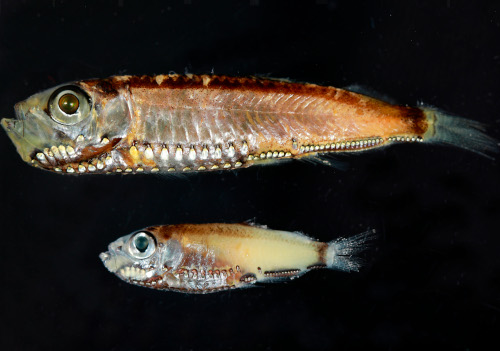 Researchers have identified a hybrid photoreceptor cell in deep-sea fish larvae that blurs the line between rods and cones, and the finding could have real implications for eye disease treatment and low-light imaging technology.
A study published in Science Advances has uncovered a previously unknown type of visual cell in the larvae of deep-sea fish, challenging a foundational principle of vertebrate vision that has stood for more than 150 years.
The research, led by Dr Fabio Cortesi from the University of Queensland's School of the Environment, examined the retinas of fish larvae belonging to two pearlside species, Maurolicus muelleri and Maurolicus mucronatus, collected from depths of 20 to 200 metres in the Red Sea during a series of marine exploration voyages.
"For more than 150 years, textbooks have taught that vision in most vertebrates is made of cones and rods — cones which work in bright light and rods for dark situations," Dr Cortesi said. "But our study of deep-sea fish larvae revealed a new cell type — a photoreceptor that optimises vision in gloomy or twilight conditions."
The newly identified cell combines the molecular machinery and genes of cone cells with the physical shape and structure of rod cells, effectively merging the strengths of both systems to create something purpose-built for low-light environments.
"This hybrid cell has the best bits of both the bright light and dark light systems to be something new that's really efficient for twilight vision," Dr Cortesi said.
A Tiny Window Into a Vast, Dim World
The technical challenges of the work were considerable. Co-researcher Dr Lily Fogg noted that the larvae studied are only half a centimetre long, with eyes smaller than a millimetre. The team sought to understand how vision develops in the fish during their early life stages, when they inhabit the dimly lit upper ocean layers before eventually descending to depths of up to one kilometre as adults.
"We wanted to investigate how their early vision develops in half-light closer to the surface, where they feed and grow before descending into one of the dimmest and largest habitats on Earth," Dr Fogg said.
Implications for Eye Disease and Imaging Technology
Beyond the fundamental science, the research team is optimistic about practical applications across both medicine and technology. Dr Cortesi suggested the discovery could inform the development of more efficient low-light cameras and goggles that don't sacrifice image sharpness, potentially relevant to surgical, defence, and consumer imaging applications.
For eyecare professionals, the medical implications may be of particular interest. The researchers believe that understanding how these fish construct hybrid photoreceptors under the extreme pressures of the deep ocean could expose new biological pathways relevant to human eye conditions, including glaucoma.
"Learning how these fish build this type of visual cell in the high-pressure environment of the deep ocean could unlock new biological pathways relevant to human eye conditions such as glaucoma," Dr Cortesi said.