


Chairside 3D-Printed Contact Lenses Move a Step Closer With New Silicone Platform
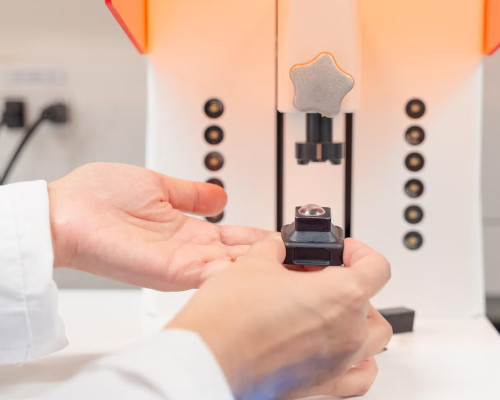 Canadian researchers have demonstrated a chairside-style workflow for rigid contact lenses that takes a patient's corneal data from digital design to a finished, coated lens in under 20 minutes, in a peer-reviewed study that adds independent technical detail to a University of Waterloo announcement of the same work.
The platform, described in Materials & Design by a University of Waterloo team led by Dr Xiaowu Shirley Tang, pairs a purpose-built hydrophilic silicone-acrylate resin with digital light processing (DLP) vat photopolymerization printing and a novel non-contact "fluidization" coating step. Together, the researchers argue, these solve two longstanding barriers to digitally manufactured rigid gas-permeable lenses: getting a silicone-based ink to print at all, and getting rid of the layer-lines that 3D printing leaves on curved optical surfaces.
From topography map to lens
Rigid lenses remain important for patients with irregular corneas, keratoconus or those undergoing orthokeratology, but conventional fabrication relies on lathe-cutting standardised blanks, a process the authors say inherently limits geometric customisation and drives the iterative, multi-visit fitting process familiar to practitioners.
In the Waterloo platform, corneal topography data, lens diameter, base curve and edge thickness are fed into a MATLAB-based algorithm that calculates sagittal depth at each radial point and generates an independent, spatially resolved thickness map. Inner and outer lens surfaces are then stitched into a solid model and exported as an STL file for printing. The paper's design examples show thickness gradients of roughly 80-200 µm across plano, three grades of myopic and hyperopic profiles, with the algorithm decoupling refractive power from structural thickness something the authors say lathe-cutting cannot achieve.
Printing itself took around 12 minutes per lens on a DLP bioprinter, with total time including washing and coating running to roughly 15–20 minutes.
Solving the staircase problem
A known limitation of layer-by-layer printing is "staircase terracing" on curved surfaces, which the study's SEM imaging showed clearly on freshly printed lenses, alongside rim striations and micro-chipping. To address this without touching the lens, the team suspended printed lenses in a vertically oriented, airflow-controlled fluidized column and applied a conformal coating while the lens remained levitated.
The effect was substantial: characteristic step height fell from roughly 5.0 ± 0.8 µm before coating to about 1.2 ± 0.3 µm after, a 75–80 per cent reduction, while cryo-fractured cross-sections confirmed the underlying sagittal shape and rim thickness were preserved. The authors note this contact-free approach avoids the edge pooling and thickness distortion that can occur with conventional dip- or spin-coating on curved ophthalmic geometries.
Performance benchmarked against a commercial lens
The printed lenses were compared directly against a commercial hard lens supplied by the Centre for Ocular Research & Education. Reported results include:
- Optical transmittance exceeding 90% across the visible spectrum, and stable at roughly 90–95% over 90 days of dry storage
- Oxygen permeability (Dk) of approximately 39 barrer, within the established range for rigid gas-permeable materials
- Protein adsorption, measured via a bovine serum albumin assay, consistently lower on the 3D-printed lenses than the commercial comparator at all time points
- Mechanical stability, with tensile strength, elongation at break, Young's modulus and toughness essentially unchanged after cleaning with Clear Care Plus® and 90 days of dry storage
- Hydrolytic stability, with mass fluctuations under ±0.2% during 90 days' immersion in PBS
- Cytocompatibility, with human corneal epithelial cell viability remaining above roughly 95% over 5 days, comparable to the commercial lens
Print repeatability was also tested across three pairs of plano lenses, yielding thickness values of 200 ± 3 µm under 2% variation.
What it means for practice
The paper positions the work as a proof of a scalable digital pathway rather than a clinical product: the authors describe laboratory validation only and flag that in vivo studies are the logical next step, which aligns with the university's statement that the team is preparing for such trials alongside a provisional patent filing on the silicone material.
For practitioners, the appeal is the prospect of collapsing the prescription-to-lens cycle, currently often weeks of iterative adjustment for complex fits, into a same-visit process once the technology matures and clears clinical and regulatory hurdles. The project, developed in partnership with the Centre for Eye and Vision Research (a joint Waterloo–Hong Kong Polytechnic University institute), was awarded a Gold Medal at the Shanghai International Exhibition of Inventions in June 2026.